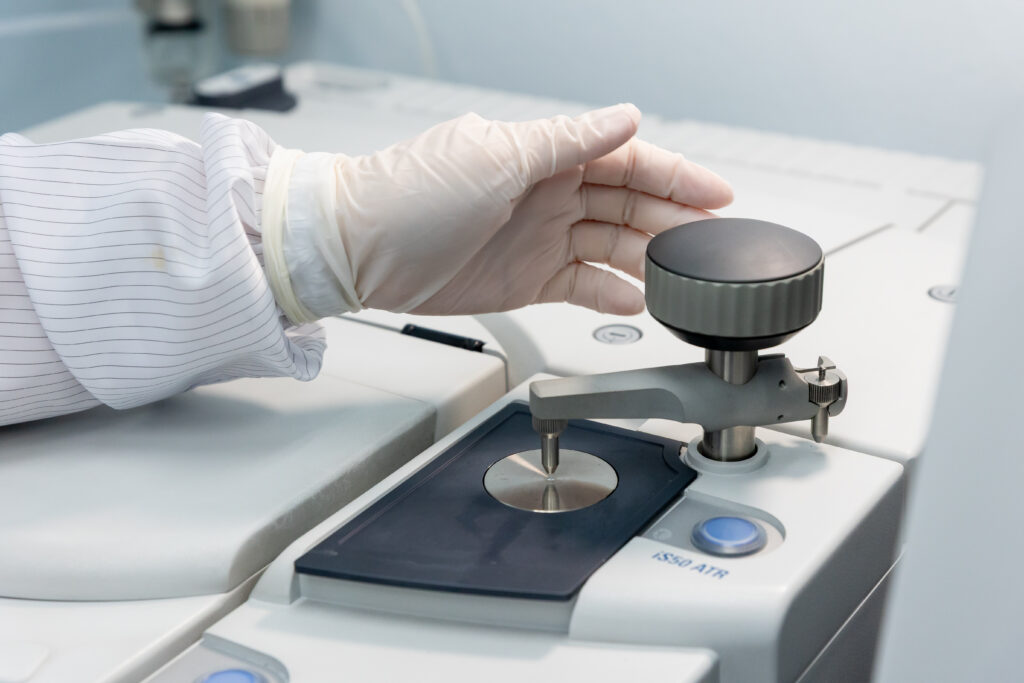
FTIR and Microscope FTIR Analysis
- โชว์สินค้าทั้งหมด
- No categories
September 1, 2026
Fourier Transform Infrared Spectroscopy · Microscope FTIR · Organic Contamination · Polymer Identification · Residue Analysis
ISO/IEC 17025 Accredited Testing Where Applicable | FTIR and Microscope FTIR Capability | Automotive Failure Analysis
A fracture surface has been imaged by SEM. EDX has identified the elements present. But the contaminating film on the contact surface, the residue beneath a delaminating coating, or the foreign particle on the filter membrane still cannot be identified by imaging or elemental analysis alone. The material is organic, and organic materials require a different analytical technique.
FTIR spectroscopy is that technique. It identifies organic materials by measuring how they absorb infrared light and comparing the resulting spectrum against reference data, producing a material identification that SEM and EDX cannot provide. In automotive failure analysis and contamination investigation, FTIR is not a replacement for SEM. It is the complementary technique that closes the gap SEM leaves open.
How FTIR Works
Fourier transform infrared spectroscopy exposes a sample to infrared radiation across a defined wavelength range. Different chemical bonds within the sample absorb infrared energy at characteristic wavelengths. The instrument measures which wavelengths are absorbed and which pass through, producing a spectrum that represents the molecular fingerprint of the material.
This fingerprint is compared against a reference library of known spectra. When a match is found, the material is identified. When an exact match is not found, the spectrum can still characterise the chemical class of the material, distinguishing, for example, a polyamide from a polyester, or an epoxy from a silicone.
FTIR is a non-destructive technique for most sample types. The measurement does not consume or alter the sample, which means other analytical techniques can be applied to the same sample after FTIR analysis. This is particularly important in failure analysis, where the available sample may be small and every analysis step needs to be planned in sequence.
Bulk FTIR and Microscope FTIR, Two Distinct Capabilities
Bulk FTIR and Microscope FTIR, Two Distinct Capabilities. FTIR is available in two configurations, each suited to different sample types and analytical objectives.
Bulk FTIR analyses a macroscopic sample across the entire exposed surface or a defined area. It suits material characterisation of solid samples, films, coatings, and extracted residues where the material is relatively homogeneous. Common applications include:
Identifying the polymer type of a seal, gasket, or housing material
Characterising an adhesive or sealant
Identifying a contaminating film extracted from a component surface
Microscope FTIR focuses the infrared beam onto a specific, localised area using a coupled microscope, allowing identification of organic contaminants as small as 20 micrometres. It is used when:
Contamination is spatially localised
A single particle or small residue area needs to be identified without contribution from surrounding material
Contamination is embedded within a larger sample and must be characterised in place
What FTIR Can Identify in Automotive Applications
FTIR is applicable across a wide range of organic material types encountered in automotive components and failure investigations.
Material category
Typical FTIR application
Polymers and plastics
Identifying seal materials, housing resins, trim polymers, and polymer contaminants
Elastomers and rubber
Characterising gaskets, O-rings, and sealing elements by polymer type
Adhesives and sealants
Identifying adhesive type and cure state in bonded assemblies
Coatings and paint
Characterising coating chemistry and identifying delamination-related residues
Oils and lubricants
Identifying lubricant type, degradation products, and oil contamination
Organic residues and films
Identifying flux residues, processing chemical residues, and organic contamination films
Fibres
Identifying synthetic and natural fibre types in contamination investigations
Particles on filter membranes
Identifying organic particles extracted during cleanliness testing
FTIR is not suitable for elemental or inorganic material identification. It does not identify metals, metal oxides, or inorganic minerals with the same specificity as EDX. Where a sample contains both organic and inorganic components, FTIR and SEM-EDX are applied together, each contributing the information the other cannot provide.
FTIR in Automotive Failure Analysis
In a structured failure analysis investigation, FTIR typically follows visual and optical examination and SEM-EDX analysis. By the time FTIR is applied, the analyst usually has a clear hypothesis about what the organic material might be, and FTIR provides the confirmation or identifies an unexpected material that changes the direction of the investigation.
FTIR in Automotive Failure Analysis, Common Scenarios
Coating delamination and adhesion failures. When a coating or bonded layer separates from its substrate, the locus of failure often involves an organic residue or film at the interface. FTIR can identify whether this film is a processing chemical, a lubricant, a mould release agent, or an incompatible primer that prevented adhesion.
Seal and gasket failures. When a seal fails to contain fluid pressure, the seal material may have degraded, swollen, or hardened due to chemical incompatibility with the fluid it is sealing. FTIR identifies the seal polymer type and, in conjunction with comparison samples, can detect chemical degradation through changes in the infrared spectrum.
Contamination source investigation. When organic particles are found on precision component surfaces, on filter membranes from cleanliness testing, or on electrical contact surfaces, FTIR identifies the material. A fibre identified as a specific synthetic polymer type can be traced to a known packaging or cleaning material. A particle identified as an epoxy resin can be traced to an assembly process. This material identification guides corrective action by pointing toward a specific source rather than leaving the contamination origin unresolved.
PCB and electronics failure analysis. Organic residues and films on PCB assemblies, connector contacts, or electronic component surfaces are a common cause of reliability problems. FTIR identifies whether the residue is flux-related, lubricant contamination, or an organic film from handling or packaging, complementing IC analysis of ionic species and SEM-EDX elemental data.
FTIR and SEM, Using Both Techniques Together
FTIR and SEM are complementary techniques that address different questions about the same sample.
Technique
What it provides
SEM
High-magnification surface imaging and morphology
EDX
Elemental composition at specific points, lines, or areas
FTIR
Molecular identity of organic materials
Microscope FTIR
Molecular identity of localised organic contaminants down to 20 µm
Together, they cover both the inorganic and organic dimensions of a contamination or failure problem. A typical combined workflow proceeds as follows: SEM imaging locates a residue or particle at the failure site. EDX confirms the particle is carbon-rich, consistent with an organic material, but cannot identify what type. Microscope FTIR is then applied to the same particle, identifying it as, for example, a polyurethane foam fragment consistent with packaging contamination.
This combination is particularly valuable in cleanliness testing follow-up investigations, where organic particles identified on filter membranes by microscopic classification require material identification to support contamination source tracing. For a detailed explanation of SEM and EDX analysis, see our guide on scanning electron microscopy analysis for failure analysis.
Frequently Asked Questions
What is the smallest particle or feature that Microscope FTIR can identify?
Microscope FTIR at ALS can identify organic contaminants down to approximately 20 micrometres in size. Below this size, the infrared signal from the feature of interest may be insufficient for reliable library matching. For particles smaller than this threshold, alternative techniques such as SEM-EDX for elemental analysis or Raman spectroscopy at specialist facilities may be more appropriate.
Can FTIR identify inorganic contamination?
FTIR is primarily a technique for organic material identification. It can detect some inorganic compounds, particularly those with strong infrared absorption bands such as carbonates, sulfates, and silicates, but it is not the primary technique for inorganic identification. SEM-EDX is the appropriate method for elemental and inorganic material characterisation.
Do I need to send a separate sample for FTIR analysis, or can it be performed on the same sample used for SEM?
In most cases, FTIR can be performed on the same sample used for SEM analysis, provided the sample has not been coated with a conductive layer for SEM. Where a conductive coating has been applied, it may interfere with FTIR analysis depending on coating thickness and material. Discuss the planned analytical sequence with the laboratory before any sample preparation begins.
How long does FTIR analysis take? Bulk FTIR analysis of a prepared sample typically takes less than a day. Microscope FTIR analysis of localised contaminants or particles takes longer, depending on the number of features to be analysed and the complexity of the spectral interpretation. For investigations combining FTIR with SEM and other techniques, turnaround depends on the full analytical programme. Discuss timing requirements at the enquiry stage.
Next Steps
See our full Failure Analysis services including FTIR and Microscope FTIR capability
Read our guide on scanning electron microscopy analysis for failure investigation
See our Chemical and Electronics Testing services for organic residue analysis on PCBs
Contact our team to discuss a failure analysis investigation
ISO/IEC 17025 Accredited Testing Where Applicable | FTIR and Microscope FTIR Analysis | Automotive Failure Analysis Support
Read more