VOC Testing
- โชว์สินค้าทั้งหมด
- No categories
June 2, 2026
Walk into a new car and you notice it immediately. That distinctive new-vehicle smell is not a design feature. It is the combined off-gassing of dozens of materials installed in the cabin: adhesives curing under the instrument panel, plasticisers migrating from PVC surfaces, flame retardants volatilising from foam seating, solvent residues evaporating from trim adhesives. Most of these compounds dissipate over weeks and months. Some of them, at high enough concentrations, raise health concerns.
This is the problem that VOC testing for automotive interiors is designed to address. For materials and components suppliers in the automotive supply chain, VOC testing is not optional. It is a qualification gate that your interior material must pass before an OEM will approve it for production, and increasingly it is a regulatory requirement in markets where cabin air quality limits are defined by law.
This article explains what automotive VOC testing involves, which standards govern it, how the laboratory methods work, and what you need to prepare before submitting materials for testing.
What Are VOCs and Why Do They Matter in Automotive Interiors?
VOC stands for volatile organic compound. The term covers a broad class of carbon-based chemicals that evaporate readily at room temperature or under mild heating. In the context of automotive interior materials, VOCs originate from the raw materials used in manufacturing, from residual processing chemicals, and from the chemical reactions that continue as materials age, heat, and interact with each other inside the vehicle cabin.
The interior of a modern vehicle is a complex assembly of polymer components: instrument panels, door trim, headliners, seat foams, floor carpets, steering wheels, and the adhesives and coatings that hold them together. Each of these materials has a VOC emission profile. In a sealed cabin at ambient temperature, the combined emissions from all interior materials accumulate to define the overall cabin air quality.
At low concentrations, most VOCs are not acutely harmful. At higher concentrations, compounds including benzene, toluene, xylene, formaldehyde, and acetaldehyde are associated with eye and respiratory irritation, headache, and in the case of benzene and formaldehyde, longer-term health concern. The regulatory and OEM response has been to define maximum permissible emission limits for individual compounds and compound groups, enforced through material qualification testing at the supplier level.
The materials in a vehicle cabin are tested individually by the supplier before assembly. By the time a vehicle reaches the consumer, every significant interior material has been qualified against VOC emission limits. VOC testing is where that qualification happens.
For automotive materials suppliers in Malaysia and Southeast Asia, the primary VOC testing requirements come from two directions: German OEM specifications referencing VDA 278 and associated standards, and broader international specifications referencing ISO 12219. Suppliers who serve both markets, or who supply into global Tier-1 supply chains, often need to satisfy both frameworks.
The Key Standards for Automotive VOC Testing
VDA 278 Thermal Desorption Analysis
VDA 278 is the most widely referenced standard for VOC and semi-volatile organic compound (SVOC) analysis of automotive interior non-metallic materials. It is published by the VDA, the German Automotive Industry Association, and is required by German OEMs including BMW, Volkswagen Group, Mercedes-Benz, and Audi, as well as by the broader Tier-1 supply chains that serve these customers.
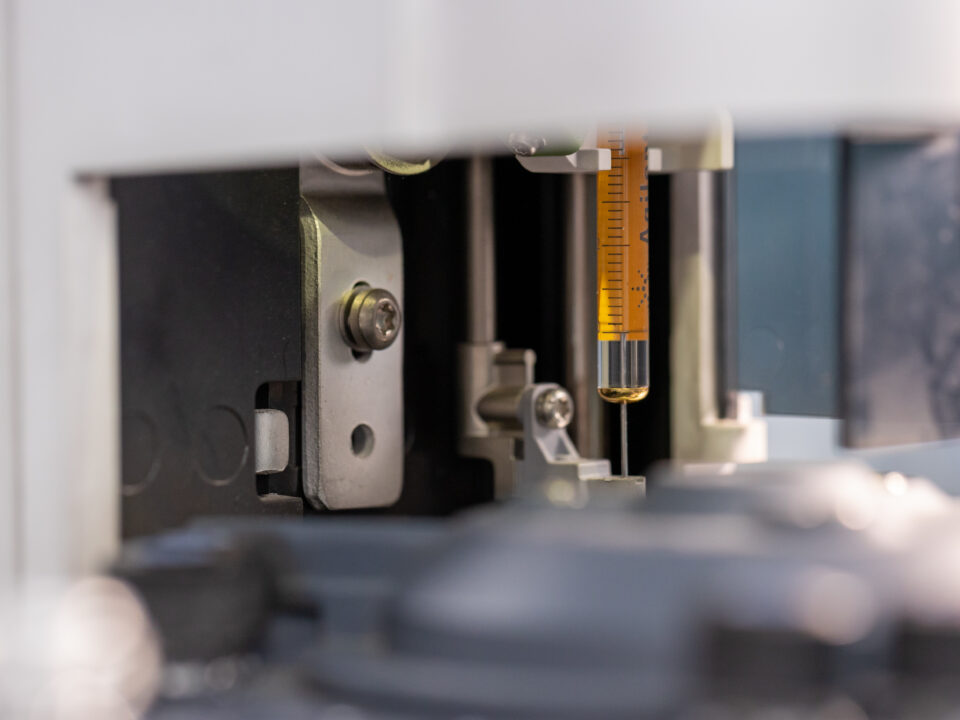
The method uses thermal desorption combined with gas chromatography and mass spectrometry (TD-GC-MS). A small sample of the material, typically one to three grams, is placed in a glass sample tube and heated in two stages. The first heating stage at 90 degrees Celsius drives off the volatile organic fraction, corresponding to compounds with boiling points up to approximately 250 degrees Celsius. The second heating stage at 120 degrees Celsius drives off the semi-volatile or fogging fraction, corresponding to higher-boiling condensable compounds.
The compounds emitted at each stage are collected on a Tenax sorbent tube, then thermally desorbed and injected into the GC-MS system for identification and quantification. Results are reported in micrograms per gram of material for the VOC fraction and separately for the SVOC or FOG fraction. Pass/fail assessment is made against the emission limits specified in the relevant OEM or customer specification.
VDA 278 produces a compound-by-compound profile of emissions. For each individual compound identified above the reporting threshold, the result includes the compound name, its CAS number, and its concentration. This level of detail is important because OEM specifications typically define limits for specific compound categories (for example, total aromatic hydrocarbons, or individual aldehyde limits) rather than a single total VOC number.
ISO 12219 The International Standard Series
ISO 12219 is a multi-part international standard covering VOC measurement in vehicle interiors. Different parts address different aspects and scales of measurement.
ISO 12219-1 covers VOC measurement in complete vehicle cabins using the bag method: the vehicle is sealed under defined conditioning conditions and a sample of cabin air is collected in a Tedlar bag for subsequent analysis. This is used for type approval and vehicle-level compliance, rather than material-level supplier qualification.
ISO 12219-2 through to ISO 12219-7 cover VOC emission measurement from individual components and materials using chamber methods of varying scales, from large climate chambers down to micro-scale chamber devices. These methods are used at the material and component qualification stage and are referenced by OEM specifications that align with ISO rather than VDA frameworks.
For most materials suppliers, the relevant parts of ISO 12219 are those covering component-level testing, which is where individual materials are assessed before vehicle assembly. If your OEM specification references ISO 12219, confirm which specific part or parts are required and at what test conditions.
VDA 275 Formaldehyde by Photometric Analysis
Formaldehyde is a specific VOC that receives dedicated attention in automotive interior specifications. It is emitted from wood-based composites, certain adhesives, and resins used in interior components, and is subject to individual emission limits that are typically tighter than the general aldehyde group limits applied in thermal desorption analysis.
VDA 275 defines a bottle method for formaldehyde determination: the sample is placed in a sealed glass bottle with distilled water and conditioned at 60 degrees Celsius for three hours. The formaldehyde emitted into the headspace dissolves in the water and is quantified by UV-Vis spectrophotometry using a colorimetric reagent. Results are expressed in micrograms per gram of material. This dedicated method is more sensitive and specific for formaldehyde than the thermal desorption approach used in VDA 278, and is required separately by most German OEM specifications.
ISO 6452 Fogging Testing
Fogging is a related but distinct phenomenon. It refers to the deposition of condensable vapours from interior materials onto the vehicle windscreen as a visible film. The fog film impairs driver visibility and is particularly problematic in cold weather conditions when the windscreen temperature is low enough to promote condensation. ISO 6452 defines both gravimetric and photometric methods for fogging assessment.
In the gravimetric method, a sample is heated in a glass beaker and the vapours condense on a cooled aluminium foil disc placed above the sample. The mass of the deposit is the fogging result. In the photometric method, the deposit forms on a glass disc and is measured by change in reflectance before and after the test. Different OEM specifications reference different methods and apply different acceptance criteria.
Where HPLC Fits in VOC Testing
High performance liquid chromatography (HPLC) is not the primary technique in automotive VOC testing, where thermal desorption GC-MS is the dominant method. However, HPLC plays a specific and important role in the analysis of certain compounds that are not well-served by GC-MS approaches.
The most significant application of HPLC in automotive VOC testing is the analysis of carbonyl compounds, particularly aldehydes and ketones. Formaldehyde, acetaldehyde, acrolein, benzaldehyde, and other carbonyls are collected by drawing air or headspace vapour through a cartridge impregnated with 2,4-dinitrophenylhydrazine (DNPH). The carbonyl compounds react with DNPH to form stable hydrazone derivatives, which are then eluted from the cartridge and analysed by HPLC with UV detection.
This DNPH-HPLC method provides better sensitivity and specificity for individual aldehyde species than thermal desorption GC-MS, and is specified by some OEM and regulatory frameworks for carbonyl compound determination. ISO 16000-3, which covers determination of formaldehyde and other carbonyl compounds in indoor air, uses this DNPH-HPLC approach, and it is applied in some automotive interior air quality programmes where individual aldehyde quantification to low levels is required.
HPLC is the method of choice when individual aldehyde species including formaldehyde need to be quantified at concentrations below the practical range of thermal desorption GC-MS, or where a regulatory framework specifically requires the DNPH-HPLC approach.
If your specification references a DNPH-HPLC method for aldehyde determination, please confirm this requirement at the enquiry stage so our team can advise on the appropriate approach for your application.
Which Materials Require VOC Testing?
Any non-metallic material used inside the vehicle cabin is a potential candidate for VOC testing. In practice, the materials that receive the most attention are those with the highest emission potential or the largest surface area exposed to cabin air.
Material Category
Primary VOC Concern
Typical Standard Applied
Instrument panels and dashboard covers
Aromatic hydrocarbons, plasticisers (SVOC/FOG)
VDA 278, OEM-specific
Headliners and roof lining
Formaldehyde from binder resins, aldehyde compounds
VDA 278, VDA 275
Seat foam (polyurethane)
Amine compounds, acetaldehyde, TDI residues
VDA 278
Floor carpets and underfelt
Formaldehyde from latex binder, styrene
VDA 278, VDA 275
Door trim panels
Aromatic hydrocarbons, plasticisers
VDA 278
Adhesives and sealants
Solvents, residual monomers
VDA 278, customer-specific
Coatings and paints (interior surfaces)
Solvents, residual monomers, reactive diluents
VDA 278, ISO 12219
Steering wheel covers and grips
Plasticisers, rubber processing aids
VDA 278, fogging ISO 6452
Rubber seals and gaskets (interior-facing)
Sulfur compounds, plasticisers
VDA 278
Wire insulation and cable jacketing
Plasticisers, flame retardant emissions
VDA 278, customer-specific
The test requirement is typically defined in the material specification or the OEM supplier quality manual. If you are uncertain whether your material requires VOC testing and to which standard, the starting point is the customer’s material specification document or the PPAP requirement list for the programme.
The VOC Testing Process: From Sample to Report
Sample Conditioning and Preparation
The conditioning of material samples before testing is defined by the standard and significantly affects the results. VDA 278 specifies that samples should be conditioned at 23 degrees Celsius and 50 percent relative humidity for seven days before testing, in a clean environment free from interfering VOC sources. This conditioning period allows the initial burst of highly volatile compounds from freshly manufactured or packaged materials to stabilise, so that the test reflects the material’s emission profile under conditions more representative of normal cabin use.
The sample size is defined by VDA 278: typically one to three grams of material, cut to fit the sample tube. Sampling location matters for heterogeneous materials – the test result reflects the specific layer or region of the material that was sampled, not necessarily the entire component. For composite materials with multiple layers, different layers may be tested separately if their VOC profiles are likely to differ significantly.
Thermal Desorption and GC-MS Analysis
The conditioned sample is placed in the thermal desorption tube and the tube is loaded into the thermal desorption unit. The tube is purged with carrier gas while being heated to the first temperature stage (90 degrees Celsius for the VOC fraction), and the desorbed compounds are collected on the cold Tenax trap. The trap is then rapidly heated and the collected compounds are injected as a concentrated plug into the GC column.
Separation by gas chromatography resolves the mixture of compounds into individual peaks. Each peak is identified by comparison with reference compound spectra in the mass spectrometry library and confirmed by retention time matching with reference standards. Quantification uses either external calibration against reference standards of individual compounds, or a total ion chromatogram approach with a representative standard compound for groups of similar compounds.
The SVOC or FOG fraction is determined by repeating the desorption procedure at 120 degrees Celsius with a new sample or with the same sample after the VOC desorption stage, depending on the protocol specified.
Reporting and Pass/Fail Assessment
The test report lists each identified compound by name, CAS number, and concentration in micrograms per gram of material. Compounds are grouped by chemical class: aromatic hydrocarbons, aldehydes, ketones, alcohols, esters, and other categories. The total concentration within each class and the overall total VOC (TVOC) are calculated and reported alongside the individual compound data.
Pass/fail assessment is made by comparing measured concentrations against the limits defined in the applicable OEM specification. Limits may be defined as individual compound limits (for example, formaldehyde below 10 micrograms per gram), group limits (for example, total aromatic hydrocarbons below 100 micrograms per gram), and overall TVOC limits. A material fails if any individual limit or group limit is exceeded.
Common Reasons for VOC Test Failure and What to Do
Understanding why materials fail VOC tests is as useful as understanding what the tests measure. The most common failure causes in automotive interior materials are:
Residual processing solvents: adhesives, coatings, or laminates that have not been fully cured or dried before testing. The solution is typically process optimisation to ensure adequate cure or drying conditions before material dispatch.
Plasticiser migration: high-boiling phthalate or non-phthalate plasticisers from PVC or flexible polymer components contributing to the SVOC or FOG fraction. Reformulation with lower-emission plasticisers, or reduction of plasticiser loading, is the typical response.
Formaldehyde from binder resins: textile materials, wood composites, and certain foam systems use formaldehyde-based binder resins. Low-emission or formaldehyde-free binder alternatives are available for most applications.
Amine compounds from polyurethane foam: certain foam formulations emit amine compounds as the urethane reaction proceeds. Catalyst selection and foam formulation adjustment can reduce amine emissions.
Contamination during conditioning or packaging: if samples are conditioned or stored in environments with high ambient VOC levels, background contamination can elevate results. Clean conditioning environments and clean packaging materials are essential.
In most cases, VOC test failures are solvable through material formulation adjustment, process optimisation, or changes to raw material selection. The failure report from an accredited laboratory identifies the specific compounds responsible, which provides the information needed to target corrective action precisely.
VOC Testing at ALS Testing
ALS provides VOC testing for automotive interior materials to VDA 278, VDA 275, and ISO 12219 frameworks. For aldehyde-specific determination requirements, please contact our technical team to confirm the appropriate method for your specification. Our testing is conducted within our ISO/IEC 17025:2017 accredited quality management system, with results formatted to meet OEM submission requirements.
Our reports include the full compound-by-compound profile with compound identification, CAS numbers, concentrations, and pass/fail assessment against the specified limits. For clients submitting materials for German OEM qualification programmes, our reports are structured to meet the documentation requirements of the relevant OEM supplier quality system.
We serve materials suppliers and component manufacturers across Malaysia and Southeast Asia, with experience across the full range of automotive interior material types: polymers, foams, textiles, adhesives, coatings, and composite structures. If your specification falls outside the standard VDA 278 or ISO 12219 framework, our technical team will review the requirement and advise on the appropriate test method.
Summary: What You Need to Know Before Submitting
VOC testing for automotive interiors is a qualification requirement, not a formality. The standard you test to is determined by your OEM or customer, not by your preference: German OEMs require VDA 278 and typically VDA 275 for formaldehyde; international OEMs reference ISO 12219. Both frameworks require testing by an ISO/IEC 17025 accredited laboratory for formal qualification purposes.
The compounds that most commonly drive failures are residual solvents, plasticisers, formaldehyde from binder resins, and amine compounds from polyurethane processing. Identifying which compound drove a failure is the starting point for effective corrective action.
Where specifications require aldehyde-specific determination at high sensitivity, DNPH-HPLC is a complementary approach applied in addition to thermal desorption GC-MS. It is not a replacement for GC-MS, which remains the primary method across both VDA 278 and ISO 12219 frameworks.
Next Steps
See our full Materials and Environmental Testing services for automotive: https://www.alstesting.co.th/automotive-materials-environmental-testing-als-testing/
Read our detailed VDA 278 explainer including test conditions and reporting format: /blog/vda-278-explainer/
Back to Automotive Testing Hub for the full service overview: https://www.alstesting.co.th/automotive-testing-services-als-testing-laboratory/
Contact our team for a VOC testing quotation or technical discussion: https://www.alstesting.co.th/contact-us/
Read more