

Corrosion in the EV Era: Why Salt Spray Testing Matters More Than Ever

ESG and VOCs Analysis: Why Verifiable Data Is the New Standard for Sustainable Business
May 6, 2026
GC-MS Testing: The Science Behind Safe and High-Quality Products
May 7, 2026Corrosion in the EV Era: Why Salt Spray Testing Matters More Than Ever

As the automotive industry shifts into the electric vehicle (EV) age, countless components are being redesigned to be lighter, more energy-efficient, and capable of handling high-voltage electrical systems. Modern EVs are no longer built from steel alone — they incorporate aluminum alloys, mixed metals, plastics, and extensive electronics, all working together in increasingly complex structures.
But that complexity comes with a hidden risk: corrosion.
The Corrosion Challenge in Electric Vehicles
The multi-material construction of EVs creates several corrosion vulnerabilities, including:
- Localized (pitting) corrosion on aluminum and alloy components
- ⚡ Galvanic corrosion at joints where dissimilar metals meet
- Degradation of electrical connectors and busbars from salt mist and moisture
These risks are especially significant in high-humidity coastal areas, or heavily polluted urban environments, where corrosion can accelerate far faster than engineers anticipate — putting long-term user safety at risk.
The most vulnerable areas in an EV include:
- Underbody structural panels
- Battery packs and mounting brackets
- Electrical connectors and wiring trays
- Battery cooling pipes and heat dissipation plates
For both parts suppliers and original equipment manufacturers (OEMs), managing corrosion is not just about aesthetics — it directly affects safety, reliability, and long-term costs. This is where the Salt Spray Test becomes essential.

What Can a Salt Spray Test Tell You About EV Components?
The Salt Spray Test (also known as a Salt Fog Test) simulates a harsh environment of continuous salt mist and high humidity to assess how well a component resists corrosion. Here’s what it can reveal:
1. When Corrosion First Appears
One of the key metrics is recording exactly when rust or surface changes begin after the test starts. This data can be benchmarked against OEM specifications to determine pass or fail.
2. The Pattern of Corrosion
The test doesn’t just tell you whether corrosion occurs — it shows how it occurs. Engineers can identify:
- Pitting on aluminum surfaces
- Coating delamination (peeling protective layers)
- Corrosion at dissimilar-metal junctions
These insights help manufacturers pinpoint whether the root cause lies in the component design, surface preparation, or the coating process itself.
3. ️ Coating System Effectiveness
For coated or painted components — such as battery brackets, underbody panels, or electric motor housings — the test verifies whether the protective coating actually works. Early peeling or rust signals a weakness in the coating formula or process that needs to be addressed.

Why Salt Spray Testing Is Critical to OEM Standards
The increased complexity and safety risks of EV structures have made corrosion testing a mandatory quality gate for OEM approval. Here’s why:
1. Reducing High-Voltage Electrical Safety Risks
Electrical connectors, busbars, and battery components are highly susceptible to oxide film formation and surface corrosion. Keeping these free from salt-induced corrosion helps prevent short circuits and abnormal heat buildup in the electrical system.
2. Ensuring Structural Reliability
Underbody frames, battery mounting assemblies, and load-bearing structures that rust prematurely can lose structural strength — with serious safety implications. Passing the Salt Spray Test to OEM standards confirms that components can withstand real-world conditions.
3. Meeting International Standards and Enabling Traceability
Global OEMs reference standards such as ASTM B117 and ISO 9227, alongside their own internal specifications. Certified lab results are critical for part approval before production begins at an industrial scale.
The data from Salt Spray Testing is not just a pass/fail verdict — it is a strategic tool that gives engineering and quality teams a clear direction for continuous improvement.
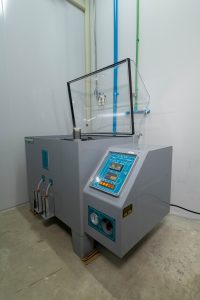
Test Your EV Components with ALS Testing
For manufacturers aiming to become suppliers to EV-era OEMs, taking Salt Spray Test data seriously can meaningfully reduce scrap rates, minimize warranty claims, and open doors to long-term business opportunities.
ALS Testing provides corrosion testing under strictly controlled Salt Spray conditions, fully aligned with international automotive industry standards — covering sample preparation, salt solution control, temperature management, and detailed reports that can be referenced directly with OEMs.
✅ Elevate your competitiveness in the global market with Salt Spray Testing from the expert team at ALS Testing — a key step toward confident OEM approval, today and into the future of electric mobility.
Interested in Salt Spray Testing services? Contact ALS Testing to learn how we can support your EV component qualification process.


